
Why Insurers Undervalue Water-Damaged Drywall After Florida Storms
The wall looks fine, the inside is soaked, and the insurer wants to pay for a coat of paint
Here’s one of the quietest ways Florida homeowners get shortchanged after a storm. The wind and rain pass, the walls look mostly okay, maybe a stain or two, and the insurer’s estimate arrives covering some patching and a coat of paint. Case closed, right? Not even close. Drywall absorbs moisture fast, and while the surface may look intact, the material inside can be thoroughly saturated. Storms leave behind water damage that isn’t immediately visible, and insurers frequently undervalue these claims by treating soaked walls like scuffed paint. Homeowners are left holding hidden damage that worsens by the week, leading to mold, weakened walls, and replacements that cost far more than the settlement covered. If that pattern sounds familiar, let’s talk about how to beat it.
Why Drywall Damage Is More Serious Than It Looks
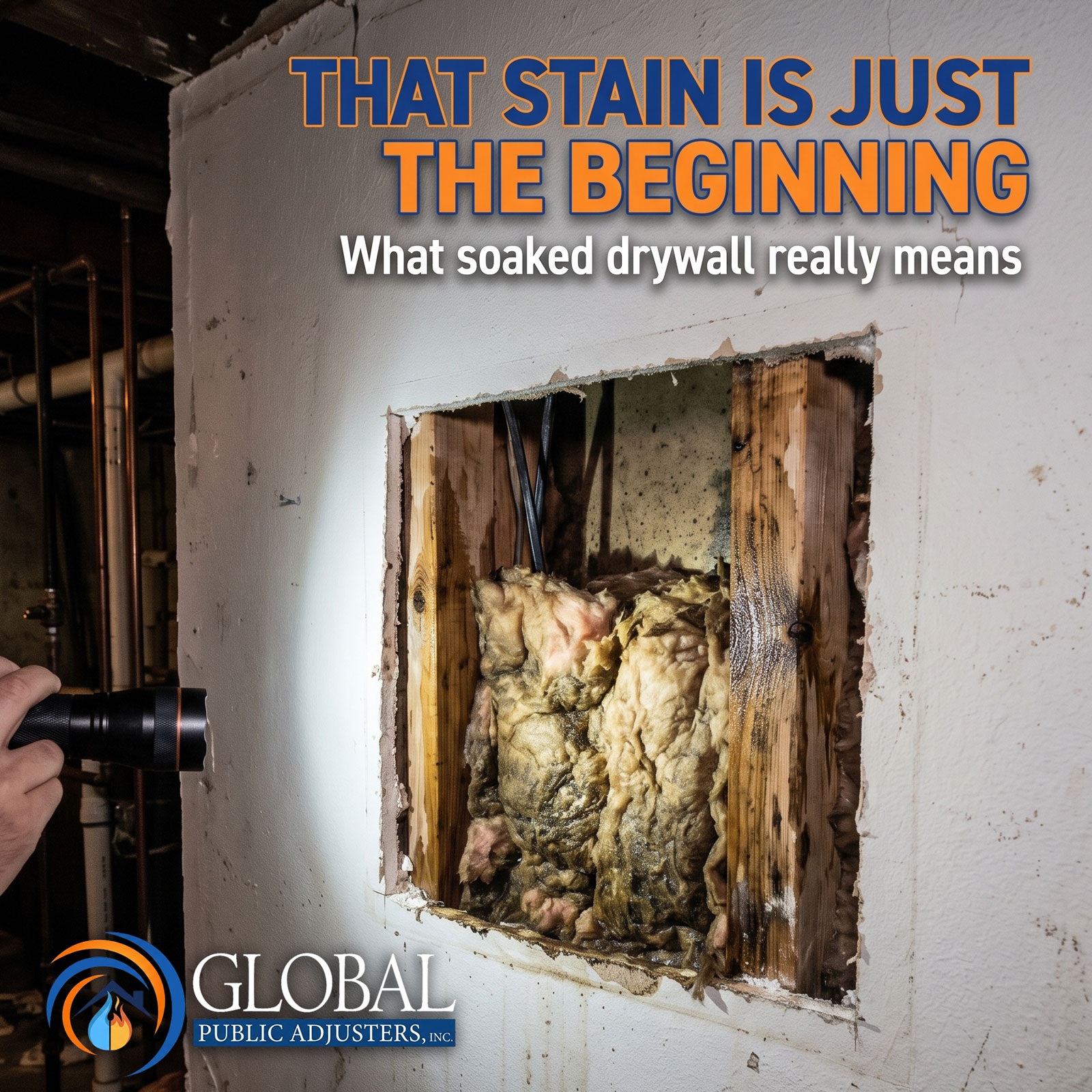
Drywall is essentially compressed gypsum wrapped in paper, and it drinks water like a sponge. That’s what makes storm intrusion so deceptive:
- Hidden moisture absorption that weakens the board’s structure from the inside, even while the painted surface still looks fine to the eye
- Insulation saturation behind the drywall that holds water against the wall cavity and spreads the damage deeper than any surface inspection reveals
Once moisture is inside the wall, it doesn’t politely dry out on its own. Florida humidity keeps the cavity damp, mold finds the paper backing within days, and the board slowly loses its integrity. That’s why so many homeowners see stains bloom or smell mustiness weeks after the storm, long after the insurer’s file was closed. The damage was there the whole time. It just hadn’t introduced itself yet.
The Cosmetic Label and What It Really Costs
Here’s the move to watch for…insurers often classify drywall damage as cosmetic, arguing that the repainting is sufficient and ignoring what’s happening inside the wall cavity. It’s a convenient classification, because paint is cheap and wall replacement isn’t. But painting over saturated drywall is literally like putting a bandage on a leaking pipe. The moisture stays, the mold grows, and the homeowner ends up paying for the real repair later, out of pocket, after the claim is long settled. Recurring stains, bubbling paint, soft spots, and musty odors are the wall’s way of announcing that the cosmetic fix didn’t touch the actual problem. That gap between what the insurer paid for and what the damage actually requires is exactly where families lose thousands.
How Homeowners Build the Case
The counterattack is evidence that shows what’s inside the wall, and it’s very buildable. Families who win these disputes take photos of wall stains as soon as they appear and keep taking them as things develop, because a dated photo series establishes the timeline and ties the damage to the storm. They request moisture readings, which are the single most powerful tool in a drywall dispute, since a moisture meter reading proves saturation in walls that look perfectly fine and gives the insurer a number they can’t argue with. Professional inspection reports documenting wet insulation and mold growth complete the picture. Surface opinions lose to internal measurements every time, and once the readings are on paper, the cosmetic argument starts falling apart.
How Global Public Adjusters Proves What’s Behind the Paint
This fight is right in our wheelhouse, so to speak and our public adjusters work exclusively for policyholders, and we know exactly how to make hidden drywall damage visible. We take the moisture readings, use thermal imaging to map how far the water traveled, document the saturated insulation and early mold growth, and assemble it all into a claim the insurer can’t wave off with a paint allowance. Then we negotiate until the settlement covers the real scope, proper drywall replacement, dried cavities, and a wall that’s actually sound. Living with hidden water damage feels unsettling, and families worrying about mold exposure and weakened walls deserve better than a cosmetic label. We make sure they get it.
Did your insurer undervalue your drywall damage after a storm? Don’t settle for a paint job on a saturated wall. Contact Global Public Adjusters today for a free claim review, and let’s prove what’s really behind the surface.
