
Why Contents Claims Are Becoming More Complex After Storms
The Stuff Inside Is Worth More Than It Used To Be
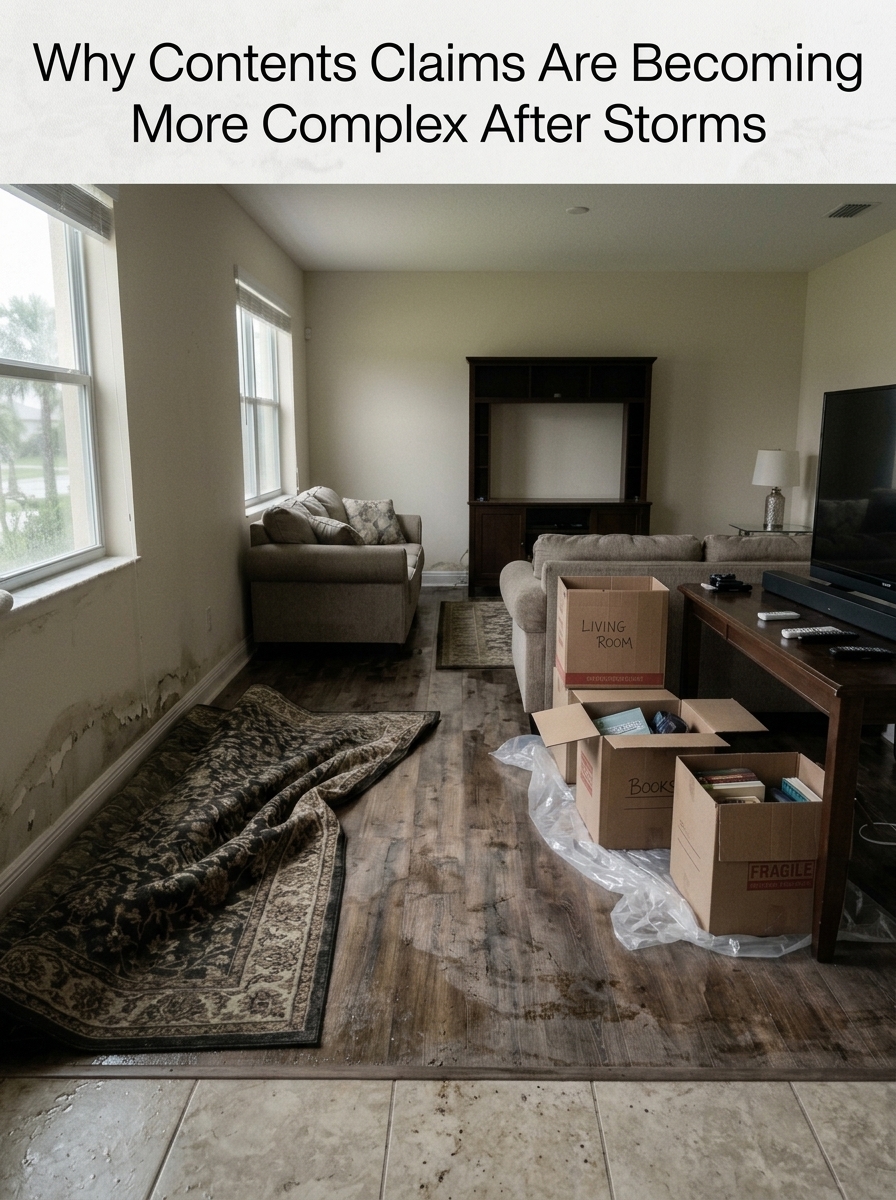
When a storm hits, attention goes to the structure. The roof, the windows, the walls, the water line on the drywall. Those are the visible losses and they are usually the largest single number on a claim.
But contents claims have gotten dramatically more complicated, and they are where a lot of homeowners quietly lose money without realizing it happened.
Think about what is actually in a house in 2026. A television, sure, but also a mesh router system, a handful of smart speakers, video doorbells, connected thermostats, security cameras, tablets, laptops, gaming consoles, wearables, and an assortment of chargers and hubs that nobody could inventory from memory. Add a home office that got built out during the remote work years and never got un-built. Add the upgraded appliances, the good mattress, the furniture that was chosen carefully rather than grabbed on sale.
The contents of a typical Florida home represent a substantially larger share of total value than they did a decade ago. Claims processes have not entirely caught up.
Where the Valuation Goes Sideways
Depreciation is the first place things get uncomfortable. Electronics depreciate quickly on standard schedules, which sounds reasonable until you realize the schedule may not track what replacement actually costs. A four-year-old laptop might depreciate to a small fraction of its purchase price, but replacing that capability today costs what it costs.
Then there is the actual cash value versus replacement cost distinction, which is the single most consequential thing in most contents claims and the thing homeowners are least likely to have thought about before a loss. Actual cash value pays depreciated value. Replacement cost pays to replace. The difference across an entire household can be tens of thousands of dollars.
Category sublimits are the third trap. Jewelry, firearms, collectibles, business property, and fine art frequently have caps well below what people assume, and those caps apply regardless of how well you document the loss.
And smart home equipment sits in a genuinely awkward middle ground. Is a hardwired camera system contents or is it part of the structure? Is a built-in connected appliance a fixture? The answer affects which part of your policy responds and how much you receive.
The Inventory Problem Is Real
Here is the uncomfortable truth about contents documentation: it is tedious, and almost nobody does it in advance.
After a loss, you are asked to produce a room-by-room inventory with descriptions, ages, original costs, and ideally proof of ownership. For a family of four with a garage, an attic, and a decade of accumulated life, that is not a weekend project. It is hundreds of line items reconstructed from memory during one of the most stressful periods you will experience.
People forget things. They forget entire categories. Linens, kitchen equipment, tools, holiday decorations, the contents of closets. Those small items add up to real money, and an incomplete inventory is simply a smaller settlement.
How a Public Adjuster Changes the Math
Contents work is a large part of what public adjusters actually do, and it is where their involvement often produces the clearest difference.
They build the inventory systematically rather than from memory. They know which categories homeowners routinely forget and they go looking for them. They understand how to establish replacement cost for current-generation devices rather than accepting a depreciation table at face value. They know which items fall under which sublimits and how to characterize them correctly. And critically, they document in the format and detail level the carrier’s process requires, which reduces the back-and-forth that stretches claims out for months.
They also handle the pace of it. A homeowner trying to rebuild a life while also cataloging every item in it is running two full-time jobs. Handing one of them off is not a luxury.
Worth Doing Before You Need It
The best contents claim is the one you prepared for on an ordinary Sunday. Walk through your house with your phone, record video of every room, open closets and cabinets, narrate what you see. It takes twenty minutes. Store it somewhere that is not in the house. If you never need it, you have lost twenty minutes. If you do need it, you will not believe how much it is worth.
