
Understanding Business Interruption Claims
Protecting Your Bottom Line When a Business Interruption Happens
When a fire, flood, or storm damages a business property, the physical loss is visible and immediate. What’s harder to quantify — but often just as financially significant — is what happens while the doors are closed. Revenue stops. Fixed costs don’t. And the longer the recovery takes, the wider that gap grows.
Business interruption insurance exists to address exactly that gap. Understanding how it works, and what it requires, can make a meaningful difference in how completely a business recovers.
What the coverage is designed to do
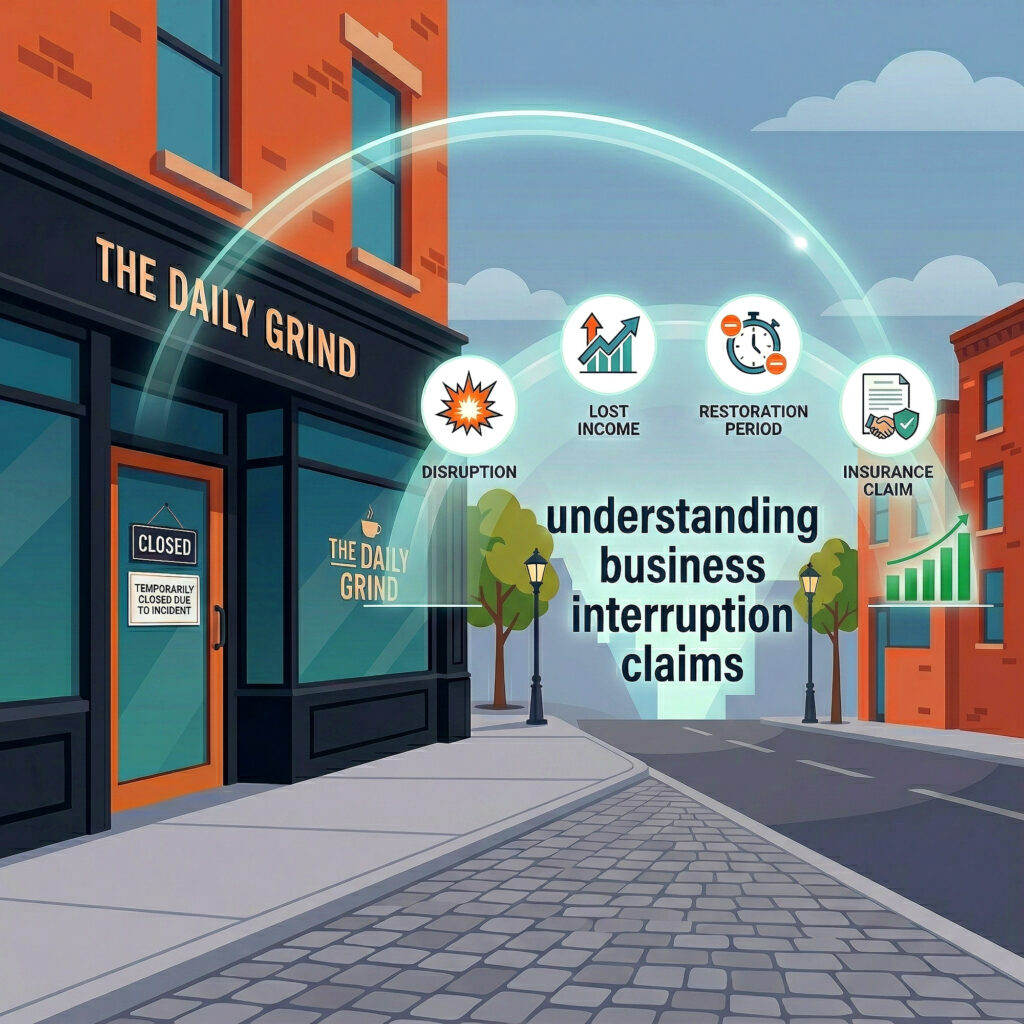
Business interruption coverage is meant to replace income lost during a period when a covered event forces operations to shut down. That includes lost revenue, ongoing fixed expenses like rent, payroll, and utilities, and in some cases the additional costs of maintaining partial operations from a temporary location. The coverage runs from the date of the loss until the property is restored and the business is reasonably able to resume normal operations.
What tends to be misunderstood
This type of coverage doesn’t activate automatically. A detailed claim needs to be filed, supported by financial records that establish what normal revenue looked like before the loss and how significantly it was affected. The documentation requirements are specific, and gaps in the record can translate directly into gaps in the recovery.
It’s also worth understanding what the policy does and doesn’t cover. Not every disruptive event qualifies. Flooding, pandemics, and supply chain interruptions may fall outside the scope of a standard policy unless those situations are specifically addressed in the language. Knowing the boundaries of the coverage before a dispute arises is far more useful than discovering them during one.
Where things get complicated
Insurers handling business interruption claims are evaluating financial projections, repair timelines, and operational records simultaneously. The process is detailed, and the room for disagreement is significant. Undervalued revenue estimates, shortened restoration timelines, and narrow interpretations of what qualifies as a covered expense are all common points of contention.
Global Public Adjusters works directly with business owners to document losses thoroughly, build accurate claims, and negotiate with insurers on the full scope of the interruption. The goal is a recovery that reflects what was actually lost — so the focus can return to getting back to work.
If your business has been impacted by a covered loss, contact our team to discuss your situation.