
The Insurance Company Has an Adjuster Working for Them. Shouldn’t You Have One Working for You?
When something goes wrong with your home and you file an insurance claim, most people assume the process is fairly straightforward. You report the damage, an adjuster comes out, they write up what they find, and the insurance company pays what’s owed.
That’s not quite how it works.
The adjuster your insurance company sends is employed by or contracted to that company. Their job is to evaluate the damage according to the insurer’s guidelines, which are designed to protect the company’s financial interests. That doesn’t mean they’ll falsify anything, but it does mean their priorities and your priorities are not the same.
A public adjuster changes that dynamic entirely.
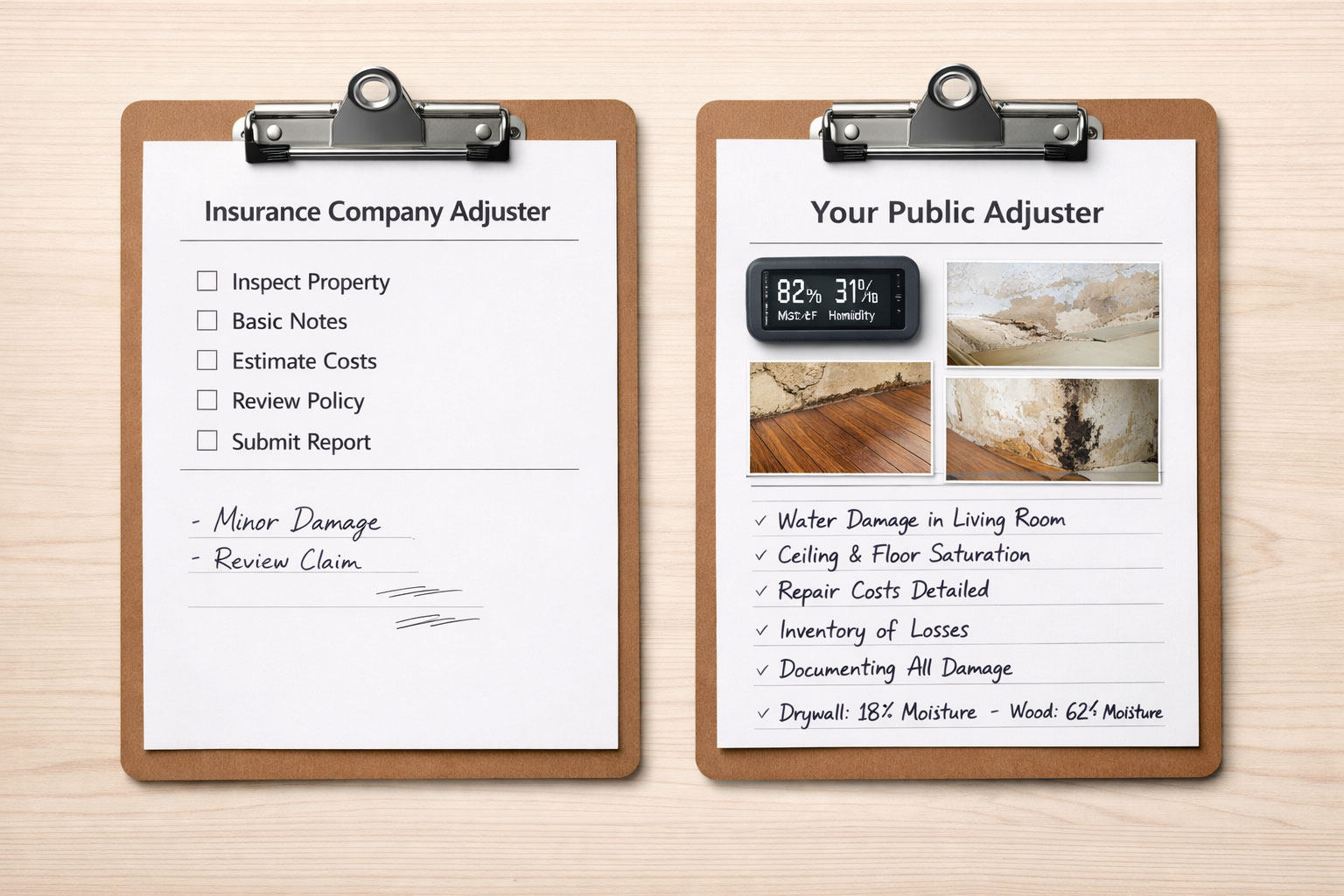
What a public adjuster actually does
Public adjusters are licensed professionals who represent policyholders in the claims process. They have no relationship with your insurance company and no financial incentive to minimize your loss. They get paid a percentage of what they recover for you, which means their interests are directly aligned with yours.
Their work begins with a thorough inspection of your property, often more detailed than what the insurer’s adjuster will conduct. They document every category of damage, cross-reference your policy language to identify everything you’re entitled to claim, prepare a complete and well-supported claim package, and then negotiate with the insurance company on your behalf.
What gets missed without one
Insurance adjusters handle a high volume of claims, and after a major storm, that volume spikes dramatically. In those conditions, it’s easy for things to be missed: hidden water intrusion behind walls, damage to detached structures, code upgrade requirements that apply when repairs exceed a certain threshold, and the full replacement value of damaged contents.
Each of these omissions can represent thousands of dollars. Homeowners who don’t know to ask about them often don’t find out until the repairs are underway and the original settlement comes up short.
The financial case for hiring one
Public adjusters typically work on a contingency basis, meaning you owe nothing if they don’t recover more than what was already offered. Because of that fee structure, homeowners have little to lose by at least having a conversation. And the data consistently shows that policyholders who work with public adjusters tend to receive meaningfully higher settlements than those who go it alone.
When to make the call
Any significant property loss is worth a conversation with a public adjuster. That includes hurricane damage, wind and hail damage, roof failures, water intrusion, fire, and smoke damage. Even if the insurance company has already made an offer, it’s not too late to bring in a public adjuster to review the claim and assess whether the offer reflects the full extent of the loss.
You paid for your insurance coverage. When the time comes to use it, you deserve to get every dollar you’re entitled to.
If you’ve had property damage and want to make sure your claim is handled fairly, visit globaladjustersfla.com or reach out to Global Public Adjusters today.
