
Securing Assets and Lowering Risk: Physical Actions and Financial Inventories for Businesses
A storm that shuts down your commercial facility for two weeks doesn’t just cost you two weeks of revenue. It triggers a cascade: vendor relationships under strain, employees in limbo, inventory potentially ruined, and an insurance claim process that can drag on for months if your documentation isn’t airtight. For Florida business owners and commercial property managers, storm preparation is a financial strategy as much as it is a facilities one.
The businesses that recover fastest after a major storm are almost always the ones that did the documentation work before it. Here’s what that looks like in practice.
Treat Asset Protection and Documentation as One Process
Most facilities teams think about physical protection and financial documentation as two separate tasks. They’re not. Every physical action you take to protect your commercial assets should have a documentation component attached to it. The two work together, and doing them simultaneously is both more efficient and more effective.
Commercial Asset | Physical Safeguard | Documentation Required |
Exterior Machinery and Infrastructure | Secure yard equipment, anchor loose storage, clear heavy debris hazards | High-resolution, timestamped photos of industrial equipment, external HVAC, and roofing conditions |
Commercial Vehicle Fleets | Move vehicles to engineered multi-story decks or verified off-site locations | Compile VINs, current mileage records, and vehicle condition logs into a secure digital database |
Warehouse Stock and Inventory | Elevate palletized inventory off the floor; cover high-value stock with heavy waterproof sheeting | Export real-time inventory reports, purchase receipts, and wholesale valuation records to cloud storage |
Working through this matrix before storm season means that if damage occurs, you’re not scrambling to reconstruct asset values from memory. You have a documented record of exactly what existed, what condition it was in, and what it was worth.
Your Financial Records Are Part of Your Claim
Business interruption coverage is one of the most valuable and most frequently underpaid components of a commercial insurance policy. The reason it gets underpaid isn’t usually because the coverage isn’t there. It’s because the policyholder can’t adequately prove what they lost.
To support a business interruption claim, you need to be able to demonstrate your projected revenue losses with actual financial records. That means backing up your last three years of tax returns, monthly profit-and-loss statements, payroll ledgers, and accounts receivable records to a secure, redundant cloud account before the season starts. If your business is forced to close because of a storm breach or a regional utility outage, a public adjuster needs that financial history to calculate your precise operational losses and present them to the carrier.
If those records are only on a local server or in a filing cabinet in your office, and that office takes on water, you’ve just made your own claim significantly harder.
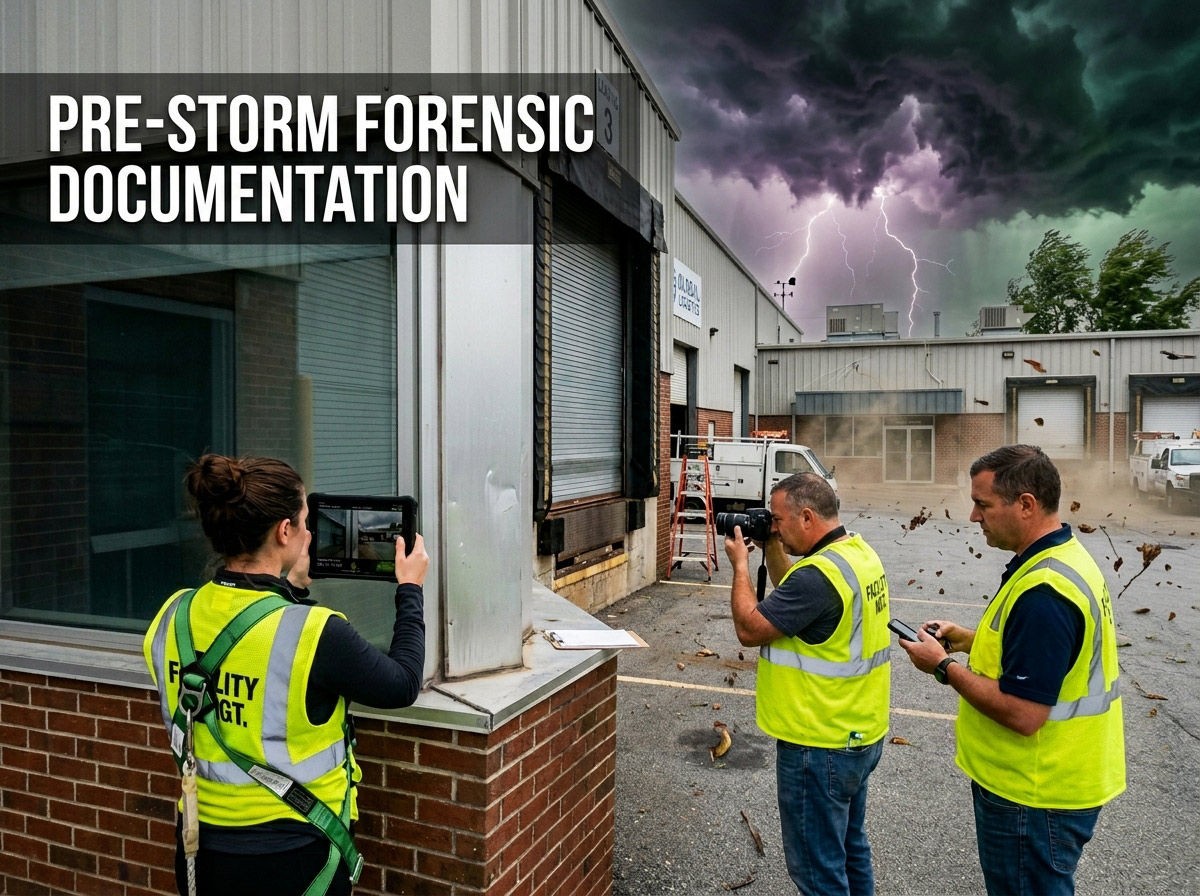
Pre-Storm Forensic Documentation Closes the Door on Disputes
Assign someone on your facility management team to do a complete visual sweep of your property before storm season and document everything they find. Commercial roofing surfaces, window glazing assemblies, exterior structural joints, the condition of loading bays and storefronts. All of it, timestamped and stored off-site.
When you have clear evidence that your facility was fully intact and operational before a storm, you eliminate one of the insurance industry’s most reliable claim-reduction tactics: the assertion that damages were pre-existing. Without your documentation, that’s a hard argument to counter. With it, there’s nothing to argue about.
Global Public Adjusters works with commercial property owners and business entities throughout Florida to build pre-storm documentation strategies and maximize recovery on commercial property and business interruption claims. Contact us today before the season starts.
