
How Adjusters Use Thermal Imaging to Detect Damage
How Infrared Technology Reveals Hidden Building Defects
Water damage has a way of hiding. A pipe bursts inside a wall, moisture seeps beneath a floor, or a slow roof leak saturates insulation for weeks before anything becomes visible. By the time the damage shows itself, it has often already spread — and what started as a contained problem has become a much larger one.
Thermal imaging exists to find what the eye cannot.
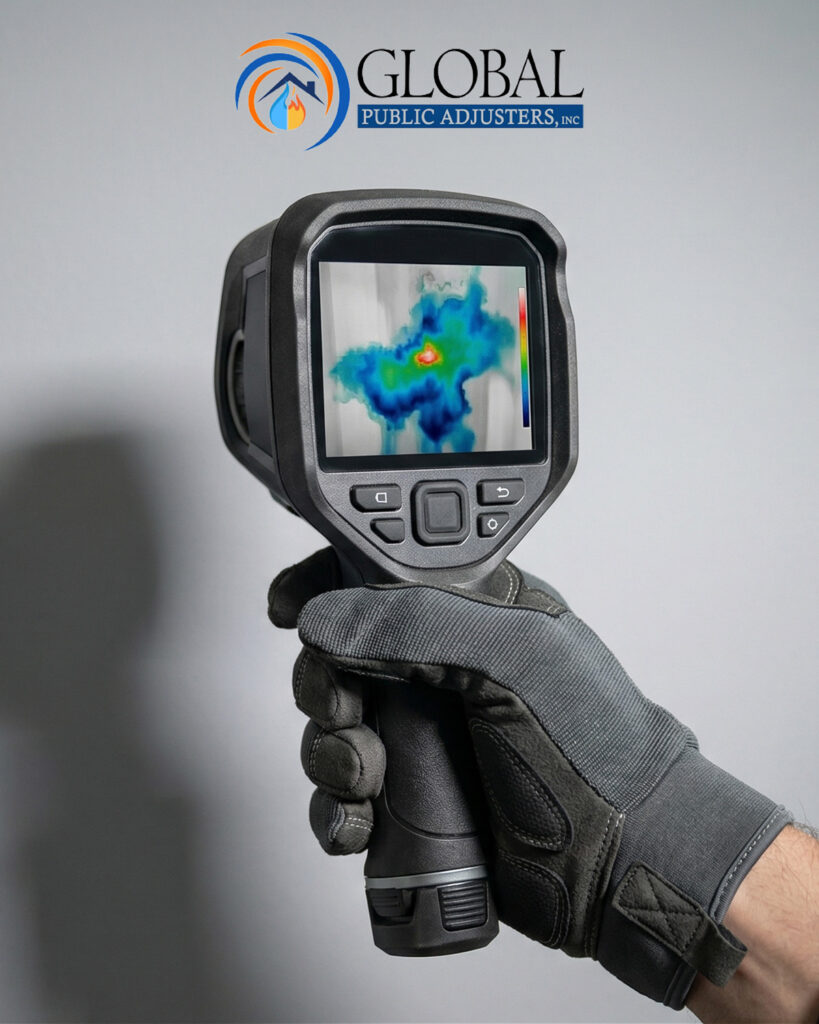
What thermal imaging actually does
An infrared camera reads surface temperature differences rather than visible light. Because wet materials tend to hold a different temperature than dry ones, a thermal camera can detect moisture behind drywall, beneath flooring, and inside ceilings without opening a single wall. The camera produces an image where cooler areas — typically where moisture is present — appear in blue or purple, while warmer dry surfaces register in red or yellow. That contrast tells a clear story about where the damage is and how far it has traveled.
Where it makes the biggest difference
Thermal imaging is particularly useful in situations where the source of damage isn’t obvious. After a storm, it can reveal water that has moved under roofing materials without visible signs of entry. Following a pipe burst or flood, it maps moisture that has migrated into wall cavities and floor systems. Around windows, foundations, and exterior walls, it identifies water intrusion points that would otherwise go undetected until structural or mold issues emerge.
Why it matters for your claim
Beyond finding the damage, thermal imaging produces documentation. The images are clear, professional, and difficult to dispute — which matters when an insurer is inclined to question the scope of a loss. A thermal scan doesn’t just support a claim; it often changes the conversation entirely by putting the evidence directly in front of the adjuster.
It is also non-invasive. No walls need to be opened, no floors pulled up, and no additional damage created in the process of finding existing damage.
Global Public Adjusters uses thermal imaging as a standard part of how we assess and document property damage. It is one of the tools that ensures nothing gets overlooked — and that your claim reflects the full extent of what occurred.
If you’ve experienced water damage and aren’t sure what’s hiding behind the surface, reach out to our team for a professional assessment.