
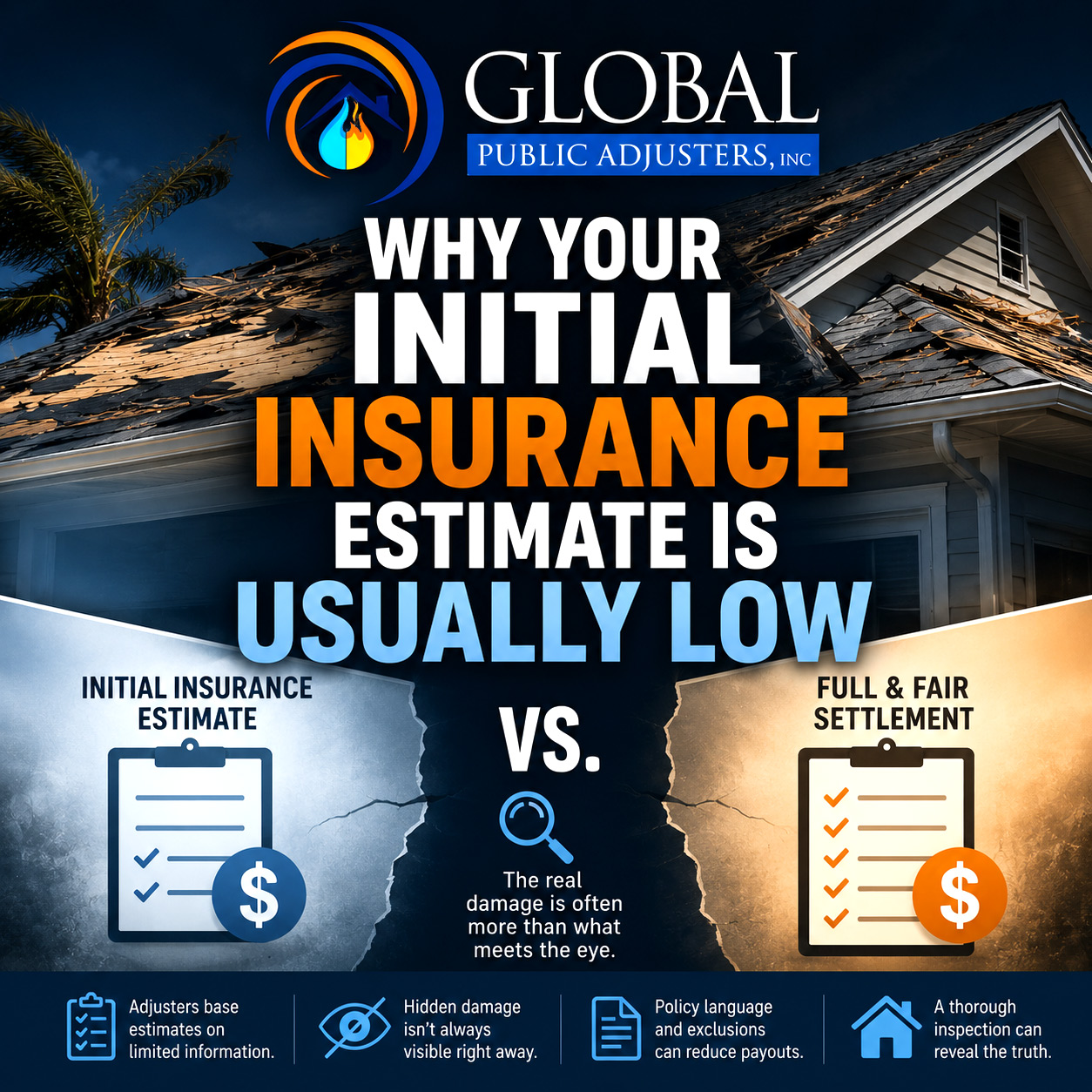
Why Your Initial Insurance Estimate Is Usually Low
There is a moment in nearly every insurance claim that catches homeowners off guard. The first estimate arrives, they open it expecting it to reflect the damage they are living with every day, and instead they find a number that seems disconnected from reality. It is lower than they imagined, and far lower than what repairs will actually cost. The natural reaction is confusion, sometimes followed by frustration. Surely there has been a mistake.
In most cases, though, it is not a mistake at all. It is a pattern, and understanding that pattern is the first step toward protecting yourself.
The Estimate Reflects Whose Interests
To understand why initial estimates run low, it helps to remember who produces them. The adjuster sent by the insurance company is working for the insurer. That is simply how the system is built. Their job is to evaluate the damage efficiently and to keep claim costs manageable from the company’s perspective.
This does not make adjusters dishonest. Many are professional and thorough within the limits of their role. But the incentives they operate under are not aligned with the homeowner’s goal of full and complete restoration. When the person assessing your loss answers to the party paying the claim, it should not be surprising that the resulting number leans conservative.
Where Initial Estimates Fall Short
Several recurring factors push first estimates below what a home truly needs. Inspections are often rushed, especially after a large event when adjusters are handling many properties in a short window. Hidden damage gets missed because it is not visible during a quick walkthrough. Pricing models can be outdated, failing to reflect the real cost of labor and materials in the current market. And documentation is frequently incomplete, capturing the obvious damage while overlooking the subtler problems that drive up repair costs.
Any one of these on its own would lower an estimate. Together, they can produce a figure that bears little resemblance to the actual cost of making a home whole again.
The Damage You Cannot See
Some of the most significant repair costs come from damage that never shows up in a casual inspection. A homeowner sees a stained ceiling or a warped floorboard, but the real problem often hides behind walls, above ceilings, and beneath flooring.
Public adjusters who dig deeper routinely uncover issues that initial estimates miss entirely. Moisture trapped behind walls can lead to mold and rot. Roof decking may be compromised even when the surface looks intact. Electrical systems can suffer damage that creates safety hazards down the line. Heating and cooling systems may be affected in ways that are not immediately obvious. Structural elements can shift, creating problems that worsen over time if they go unaddressed.
These are not minor footnotes. Hidden damage like this can dramatically increase the true cost of repairs, and when it is left out of an estimate, the homeowner is the one who eventually pays the difference.
Why the First Number Is Not the Final Word
Perhaps the most important thing to understand is that a low initial estimate is not a verdict. It is an opening position. Homeowners often treat the first number as definitive, as though the insurer has spoken and there is nothing more to discuss. In reality, claims can be reopened, supplemented, and renegotiated when new information comes to light.
The key is having that new information in hand. A thorough, independent assessment of the damage can reveal the full scope of what needs to be repaired and provide the documentation necessary to support a higher, more accurate figure. Without that second look, a homeowner has little to push back with. With it, the conversation changes entirely.
The Value of a Second Opinion
This is where independent expertise becomes so valuable. A public adjuster works on behalf of the homeowner, not the insurance company. Their entire focus is on identifying the full extent of the damage, including the hidden problems that initial inspections miss, and ensuring the claim reflects the real cost of restoration.
Think of it the way you would think of a medical second opinion. When the stakes are high, it makes sense to have someone in your corner who is looking out for your interests and who has the knowledge to spot what others overlook. The difference between an initial estimate and a properly documented claim can be substantial, and that difference goes directly into the homeowner’s pocket.
The Takeaway
A low initial estimate does not mean the insurer is right, and it does not mean the homeowner is stuck. It simply means the first assessment was incomplete, and a closer look is warranted. With the right support, homeowners can move past that disappointing first number and pursue what they are truly owed.
Received an estimate that feels too low? You do not have to accept it. Global Public Adjusters will review your claim and fight for the full amount you deserve. Reach out today for a free, no-obligation consultation.
