
Commercial Roof Damage Claims After Florida Storms
For business owners in Florida, a major storm doesn’t just mean property damage, it means disruption. Closed storefronts, halted operations, displaced employees, and revenue that simply stops coming in while repairs are sorted out. Commercial roof damage is one of the most expensive and operationally disruptive outcomes of the Florida’s storm season, and yet, the insurance claims process for commercial properties is often far more complicated than most business owners realize going in to it.
The stakes are high and the policies are often complex, and the inspections that insurance companies conduct are frequently not thorough enough to capture the full extent of what’s actually been damaged. Getting this right truly matters, not just for the insurance check, but for the long-term health of your business and your building.
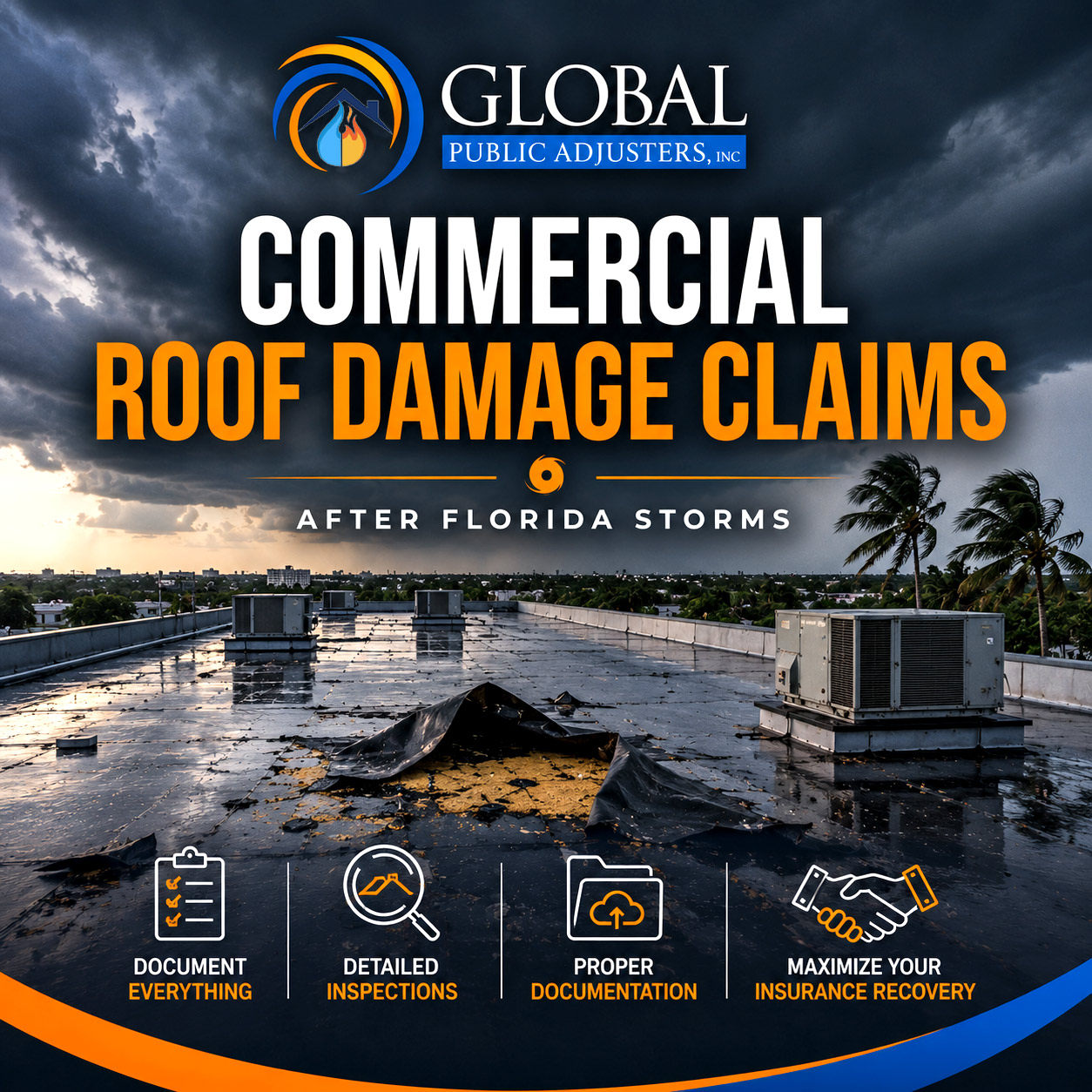
Why Commercial Roofs Are a Different Challenge
A residential roof and a commercial roof are fundamentally different systems, and that distinction matters in the context of storm damage claims. Commercial buildings often have flat or low sloping roof systems that use membrane like roofing materials rather than shingles. These systems can be highly effective but they respond to storm damage differently and the damage they sustain is often much harder to spot then traditional materials on residential.
Add to that the equipment commonly mounted on commercial roofs such as HVAC units, exhaust systems, and drainage assemblies, and you have a much more complicated damage assessment than the typical residential inspection. Flashing around rooftop equipment is a frequent failure point during high-wind events, and damage to those seals can allow water infiltration that spreads far beyond the initial point of entry. The surface area of a commercial roof also creates scale challenges. What looks like minor storm impact across a large flat membrane can translate into significant repair costs once the full scope is mapped out.
What Storm Damage Actually Looks Like on a Commercial Roof
After a significant Florida storm, public adjusters who specialize in commercial properties regularly find damage that wasn’t flagged in the initial insurance inspection. Membrane punctures from wind-driven debris are common but easy to overlook without careful examination. Wind uplift can compromise sections of the roof system that appear intact from above but have lost their adhesion underneath. Pooling water, particularly on flat roofs with compromised drainage, can create long-term moisture problems that compound really quickly.
Flashing failures, seam separations, and hidden moisture trapped beneath the surface are among the most consequential forms of damage because they aren’t visible without proper probing and testing. By the time moisture intrusion becomes obvious on the interior of the building, significant secondary damage has often already occurred to insulation, structural components, and interior finishes. This is the core challenge with commercial roof claims: the most expensive damage is often the hardest to see, and a surface-level inspection simply won’t find it.
The Claims Process for Commercial Properties
Commercial insurance policies are considerably more complex than residential ones. Coverage tiers, business interruption provisions, code compliance upgrades, and tenant considerations all add layers that require careful review. One of the most common ways business owners lose money in the claims process isn’t through outright denial—it’s through incomplete documentation that results in a settlement that doesn’t account for the full scope of covered losses.
It’s important to know about code compliance as it is a frequently overlooked area. Florida’s building codes have been updated significantly over the years, and when a commercial roof requires replacement due to storm damage, the insurance company may be required to cover the cost of bringing the new roof up to current code standards, not just replacing what was there! That’s a meaningful and usually significant dollar difference in many claims.
Business interruption coverage is another area where proper documentation makes an enormous difference. If your operations were disrupted while repairs took place, the financial losses associated with that downtime may be recoverable, but they do require careful documentation and also a clear connection to the covered storm event.
How a Public Adjuster Protects Your Business
A public adjuster who specializes in commercial claims brings a combination of technical expertise and policy knowledge that fundamentally changes what you’re able to recover. On the technical side, they conduct thorough inspections using professional equipment like thermal imaging, moisture meters, and even core sampling to identify and document the damage that a general inspection would miss. On the policy side of things, they review your coverage in full detail, identify every applicable provision, and then prepare the comprehensive claim presentation that leaves nothing on the table.
They also serve as your representative throughout the entire process, handling communications with the insurer and pushing back when the insurer’s assessment doesn’t align with the documented facts. For a business owner who is simultaneously trying to manage a disrupted operation, having someone in that role is such an wonderful value, not just financially, but in terms of time and energy in life.
If your commercial property sustained roof damage in a recent storm, don’t navigate the claims process alone. Global Public Adjusters specializes in commercial damage claims across Florida. Contact us today for a free inspection and find out what your claim is actually worth.
