
How Adjusters Assess Roof Damage After Florida Storms
From Creases to Gutters: Why the Exterior Inspection Requires a Closer Look
Florida roofs don’t get a break. Between hurricane season, afternoon hailstorms, and the kind of wind-driven rain that finds every weak point in a structure, roof damage is one of the most common and most contested insurance claims in the state. What makes these claims complicated is that the worst damage isn’t always what you can see from the driveway.
This is where a public adjuster earns their keep.
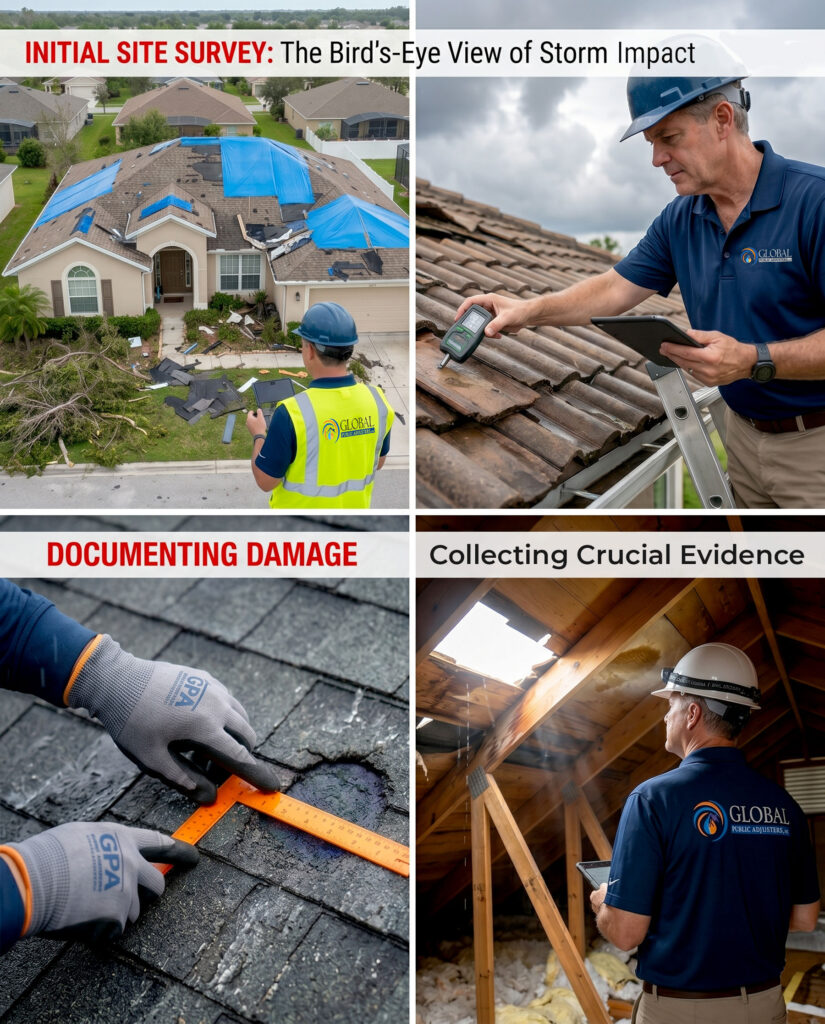
Starting Outside: The Exterior Inspection
A thorough roof inspection starts at the top and works methodically across every surface. Public adjusters are looking for missing or lifted shingles, impact marks left by hail, damaged flashing around chimneys and vents, cracked or broken tiles, and bent or separated gutters. Even shingles that appear intact can tell a story. Even a slight crease or lift along the edge is often a sign of wind damage that will worsen with the next storm and lead to water intrusion down the road.
Insurance company adjusters sometimes conduct a quick visual inspections and then move on. A public adjuster digs deeper because their job is to represent you, not the carrier.
Going Inside: What the Ceiling and Attic Reveal
Roof damage almost always leaves evidence inside the home too. Water stains on ceilings, damp or compressed insulation, early signs of mold growth, and sagging drywall all point to a compromised roof. These interior findings are important because they corroborate what’s happening on the outside and help establish how long water may have been entering the structure.
Documenting both sides of the story strengthens your claim significantly.
Reading the Policy So You Don’t Have To
A roof damage claim isn’t just about what’s broken. It’s about what your policy actually covers and how it’s interpreted. Public adjusters spend a great deal of time working through the details of a homeowner’s policy, including the difference between wind and flood coverage, hurricane deductibles, ordinance and law provisions that may cover bringing older structures up to current building code, and matching requirements for materials that are no longer available or have changed in appearance.
Many homeowners don’t realize what they’re entitled to until someone who understands the fine print sits down with their policy.
Building a Claim Package That Holds Up
Once the inspection and policy review are complete, a public adjuster compiles everything into a documented claim package. This typically includes:
- Comprehensive photo and drone evidence
- Detailed repair or replacement estimates from qualified contractors
- Moisture and thermal imaging reports
- Damage diagrams and measurements
The goal of that package isn’t just to show that damage exists. It’s to present it in a way that’s organized, supported, and difficult for an insurer to minimize or dismiss. At Global Public Adjusters, that’s the standard we hold every claim to.
